
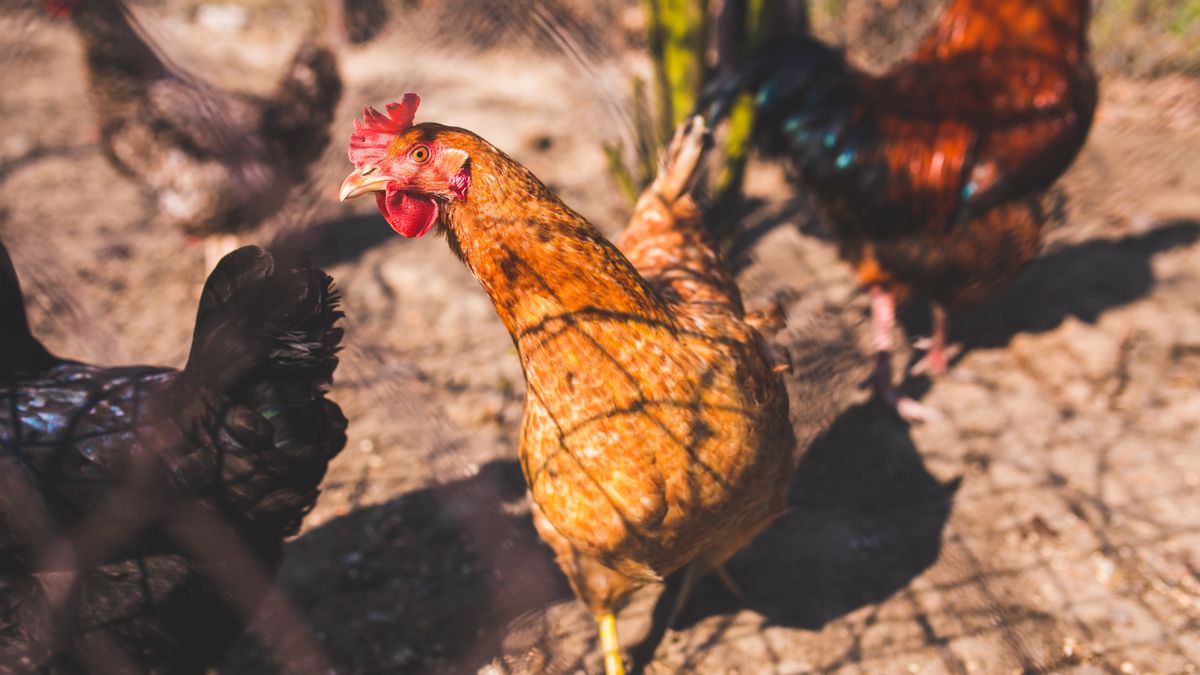
If you keep hens in a town garden or on a smallholding, you will almost certainly have foxes nearby. Urban foxes are bolder than their rural cousins, they are active in daylight as well as at dawn and dusk, and they learn quickly. A vixen teaching cubs to hunt will return to a weak point in a run night after night until it gives. This is not a reason to give up on keeping chickens — it is simply a reason to build properly the first time.
Fox-proofing is not about making a run that a fox cannot get into under any circumstances. It is about making one that is not worth the effort. A fox will test a fence, dig at a corner, and push against a roof. If every attempt meets solid resistance, it will move on to easier pickings. The three things that matter most are strong mesh instead of chicken wire, a mesh skirt buried around the base, and a fully roofed enclosure.
Standard hexagonal chicken wire is designed to keep chickens in, not foxes out. A determined fox can bite through it, and it tears easily once it starts to rust. For a permanent run, use welded galvanised wire mesh with apertures no larger than 50mm x 50mm — 25mm x 25mm is better if you have small bantams or chicks — and a wire gauge of at least 16. It costs more, but it lasts a decade or more.
Foxes dig. They usually start at a corner, a gate post, or anywhere the ground is soft. The simplest defence is an L-shaped skirt of the same welded mesh, attached to the base of the run and buried shallowly.
Dig a trench around the entire perimeter, roughly 30cm deep and 45cm wide. Lay the mesh into it so it extends outward from the run like a shelf, then backfill and firm the soil. A fox digging down at the fence line hits the mesh within a few centimetres and cannot get underneath. Weeping away from the run, rather than straight down, is what defeats them.
Electric poultry netting works well as a secondary barrier on grass, but treat it as an addition, not a substitute. It needs a good energiser, clear vegetation underneath, and regular testing.
Many keepers secure the sides and forget the top. Foxes climb, and they will drop into an open run from a shed roof, a fence panel or a wall. A roof also keeps out sparrowhawks, and it stops wild birds fouling the feed and bringing in disease.
Options that work well in a small garden:
Whichever you choose, the roof must be fixed to the same sturdy frame as the walls, with no gaps at the junction. A 10cm gap at the eaves is an invitation.
A secure run that is too small causes feather pecking, boredom and bullying. As a rough guide, allow at least 1 square metre per hen in a covered run, and closer to 2 square metres if they will be confined for most of the day. If your garden cannot manage that, reduce the flock rather than the space.
Inside the run, think about what a hen actually wants to do:
Rotate the run onto fresh ground if you can, or dig over and re-litter sections in turn. This keeps the ground from turning sour and cuts the worm burden.
Foxes have been known to nudge open simple bolts and lift loose pop-hole doors. Use a two-step latch — a bolt plus a carabiner, or a padlock — and make sure the pop-hole closes flush with no gap underneath. Fill any hole bigger than a fist, including where a downpipe or cable enters.
Once a week, walk the perimeter slowly. Look for lifted mesh, fresh digging, droppings, scratched earth at the base, and loose staples. Five minutes of checking beats a morning of counting feathers. Build it well, keep an eye on it, and your hens will scratch away happily while the fox walks past.

Hi, my name is Anthony kuber. I am artist and fashion designer.
I love to travel and writing blogging.
Your email address will not be published. Required fields are marked *
Software Developer & Writer
Hey, I'm Diva, a developer and writer blending code and creativity. I'm driven by a deep curiosity and a relentless pursuit of excellence. Join me as I craft digital solutions and captivating stories.


